Shopping Cart
No item in your cart!
RM0.00
View Cart
Malaysia No.1 Office Furniture Hub
Office furniture is a business investment. Whether you are furnishing a new office, relocating, or replacing existing equipment, understanding the total cost of ownership is often more important than finding the cheapest product.
This guide explains eight common mistakes, how to avoid them, and what to consider when choosing suitable office furniture in Malaysia.
One of the most common mistakes is selecting furniture simply because it has the lowest selling price.
An inexpensive desk may appear attractive initially, but weak construction, unsuitable materials, or insufficient functionality could lead to additional expenses.
For example, consider two hypothetical office chairs:
| Cost comparison | Chair A | Chair B |
|---|---|---|
| Purchase price | RM180 | RM350 |
| Assumed useful life | 2 years | 5 years |
| Annualized purchase cost | RM90 | RM70 |
This simplified illustration excludes maintenance and financing costs. It demonstrates why a higher-priced product can sometimes offer better value over its useful life, although actual product durability varies.
How to avoid this mistake:
Compare furniture based on construction quality, suitability, warranty coverage, expected usage, and replacement costs.
For frequently used employee workstations, prioritize dependable furniture rather than selecting solely by price.
Office employees often spend substantial time sitting at desks.
Furniture that does not accommodate different body sizes or working postures may contribute to discomfort and difficulty maintaining comfortable working positions.
When choosing office chairs, consider:
Adjustable seat height
Appropriate lumbar support
Suitable seat depth and width
Comfortable armrest positioning
Stable base and smooth movement
An ergonomic chair should fit the user rather than relying only on marketing labels.
Desk height and monitor placement are also important. Even a well-designed chair may not compensate for a workstation that is incorrectly arranged.
How to avoid this mistake:
Allow employees to assess suitable adjustments when possible. For businesses buying chairs in bulk, consider testing a sample before ordering.
Adjustable furniture provides more flexibility for employees with different needs.
Purchasing furniture before measuring the office can create unnecessary problems.
Oversized desks may reduce walking space, while incorrectly positioned cabinets can obstruct doorways or circulation routes.
A 1800 mm executive desk may suit a spacious private office but may be impractical in a compact workstation area.
Consider these common desk dimensions:
| Desk dimensions | Typical application |
|---|---|
| 1200 × 600 mm | Compact individual workstation |
| 1200 × 700 mm | Standard office desk |
| 1500 × 750 mm | Larger individual workstation |
| 1800 × 900 mm | Executive or spacious private office |
These are general product-size references, not guaranteed space-planning standards.
How to avoid this mistake:
Measure the available floor area, including doorways, columns, windows, and access routes.
Plan for chair movement, storage access, and comfortable circulation before confirming furniture quantities.
For larger projects, prepare a furniture layout based on actual room measurements.
Many SMEs purchase office furniture based only on their current workforce.
However, when additional employees join, the existing furniture arrangement may become difficult to expand.
Different desk sizes, mismatched finishes, or fixed workstation configurations can complicate future office changes.
How to avoid this mistake:
Consider your expected workforce over the next one to three years.
Ask whether the furniture can be rearranged, expanded, or relocated.
Modular workstation systems can be useful for businesses anticipating team growth.
For example, a company beginning with eight employees might consider standardized workstations rather than purchasing eight unrelated desk designs.
This can make future additions easier while maintaining a consistent office appearance.
Not every office chair is designed for the same purpose.
A visitor chair used occasionally has different requirements from a chair used for extended computer work.
Likewise, a premium-looking executive chair may not provide the adjustments needed by every employee.
Common mistakes include purchasing chairs without checking seat dimensions, ignoring adjustment mechanisms, and selecting upholstery based only on appearance.
How to avoid this mistake:
Match the chair to its intended application.
Consider mesh chairs for users who prefer breathable backrests, and upholstered options where their feel and appearance are appropriate.
Before purchasing, review the adjustment features, seating dimensions, weight capacity, and warranty terms.
For frequently occupied workstations, user suitability should take priority over appearance alone.
Insufficient office storage often results in documents, stationery, and equipment accumulating on desks.
However, purchasing too many cabinets can also waste valuable floor space.
The correct solution depends on how frequently employees access documents and whether shared storage is practical.
How to avoid this mistake:
Separate storage requirements into three categories:
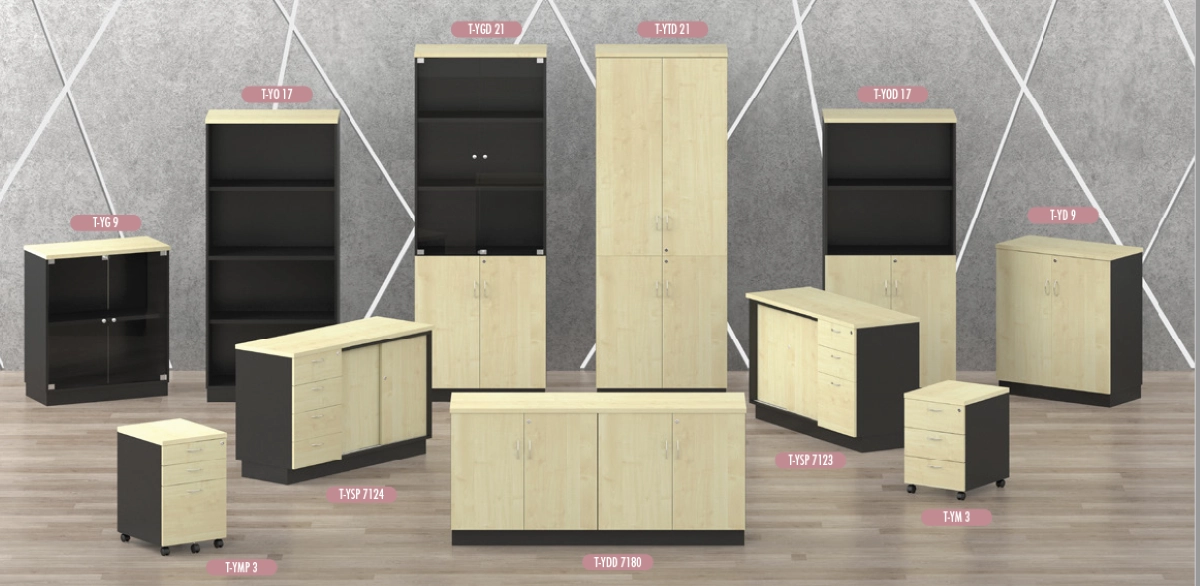
Personal storage: Mobile pedestals for everyday items
Department storage: Shared cabinets for files and supplies
Archive storage: Steel filing cabinets or cupboards for less frequently accessed records
Businesses using mostly digital documents may require less physical filing space.
Choose storage furniture according to actual requirements rather than automatically providing a large cabinet for every employee.
The listed furniture price is not necessarily the final cost of furnishing an office.
Businesses should also consider delivery charges, installation requirements, product maintenance, and applicable warranty terms.
For example, ordering furniture from different suppliers may complicate delivery coordination.
Furniture that requires assembly may also create additional work if installation is not included.
How to avoid this mistake:
Before confirming an order, check:
Total furniture cost and applicable charges
Delivery coverage and estimated lead time
Assembly or installation requirements
Warranty coverage and exclusions
After-sales service arrangements
Compare the complete quotation rather than individual product prices.
For projects involving multiple workstations, confirm site accessibility, lift availability, and any delivery restrictions before placing an order.
Office furniture should support the way a company operates while creating an appropriate professional environment.
For example, a client-facing business may prioritize reception furniture and meeting facilities, while an administrative office may require more workstations and document storage.
Buying expensive executive furniture while neglecting essential employee workstations can result in an unbalanced budget.
How to avoid this mistake:
Allocate furniture spending according to actual business priorities.
Choose consistent finishes and practical furniture arrangements across departments.
For reception and meeting areas, select designs that reflect the company's intended professional image.
Remember that an attractive office does not necessarily require the most expensive furniture. A well-coordinated, functional layout can create a professional appearance within a reasonable budget.
Before buying office furniture, prepare a simple purchasing plan.
The following checklist can help reduce unnecessary spending.
| Buying consideration | Questions to ask |
|---|---|
| Office layout | Will every item fit comfortably? |
| Employee requirements | Are the desks and chairs suitable for daily work? |
| Furniture quality | Are materials and construction appropriate? |
| Expansion | Can furniture be added or rearranged? |
| Storage | How much personal and shared storage is needed? |
| Total budget | Are delivery and installation costs included? |
| After-sales support | What warranty and service terms apply? |
Prioritize essential workstations first, followed by storage, meeting furniture, and reception requirements.
Obtain an itemized quotation so that you can compare products and quantities accurately.
MR.OFFICE Malaysia, established in 2002 and headquartered in Shah Alam, Selangor, offers office desks, chairs, workstations, cabinets, and other office furniture through its online catalogue.
Here are practical product examples that address several of the purchasing mistakes discussed above.
Suitable for: Budget-conscious businesses furnishing standard individual workstations.
Dimensions: 1200W × 700D × 750H mm
Dark Grey and Light Grey finish
Straightforward rectangular table configuration
This model is worth comparing when a compact, standardized desk is more appropriate than a large executive table.
Explore MR.OFFICE G-Series Office Tables
Suitable for: Employees who require a larger work surface and convenient storage.
Main table dimensions: 1500W × 700D × 750H mm
Includes side cabinet
Includes three-drawer mobile pedestal
Dark Grey and Maple finish
An integrated desk-and-storage combination may help avoid purchasing several unrelated furniture items.
Suitable for: Businesses comparing mesh office seating options.
The E48 is a high-back mesh chair listed in the MR.OFFICE catalogue.
Before purchasing, compare its available adjustments, dimensions, user suitability, and warranty against alternative chairs.
Avoid choosing solely by price or appearance.
Browse MR.OFFICE Office Furniture
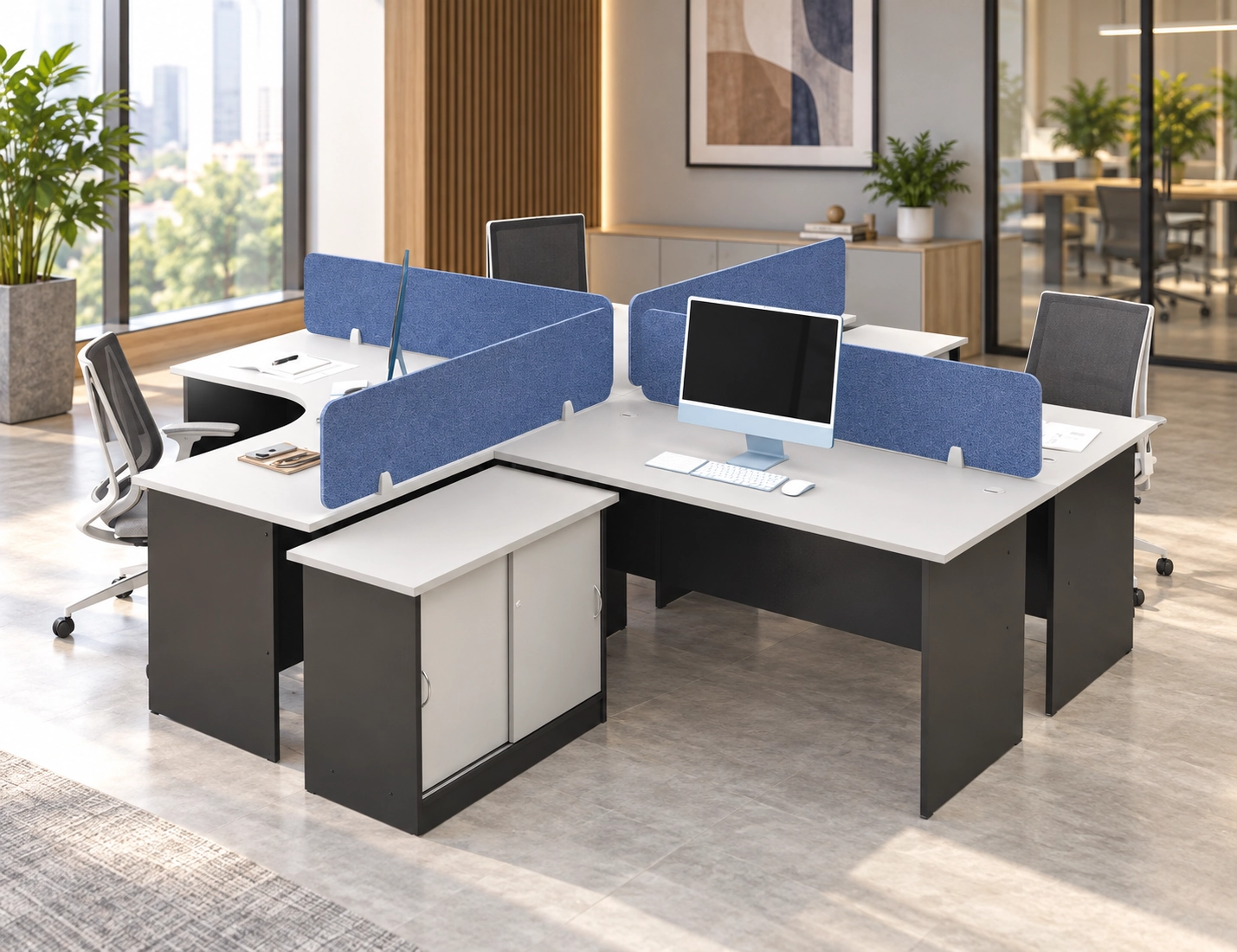
Suitable for: Businesses planning grouped employee workstations.
For example, the UT4F-1260-WHWH workstation has an overall tabletop footprint of 2400 × 1200 mm and includes desking panels.
A standardized workstation configuration can help businesses plan furniture quantities and future additions.
Explore Four-Seater Workstations
Suitable for: Employees or work areas requiring adjustable desk height.
The EHT-127-WHWH is listed with a 1200 × 750 mm tabletop and adjustable height range of approximately 710–1150 mm.
It may be worth considering where sitting and standing desk-height flexibility is useful.
Browse Height-Adjustable Tables
Suitable for: Offices managing physical documents.
Four-drawer filing cabinet
Ball-bearing drawer design
Dimensions: 460W × 620D × 1320H mm
A dedicated filing cabinet can help organize records without occupying employees' working surfaces.
Product specifications and availability should always be reconfirmed before purchase.
Choosing furniture based only on the initial price is one of the most common mistakes. Consider durability, suitability, replacement costs, and the total purchasing cost.
No. Higher prices do not automatically guarantee better quality. Compare specifications, construction, comfort, warranty coverage, and suitability for the intended use.
Measure the office first, choose standard desk sizes where appropriate, prioritize essential items, compare complete quotations, and avoid unnecessary furniture upgrades.
Review chair dimensions, available adjustments, upholstery, weight capacity, warranty coverage, and suitability for different employees.
Businesses can explore office furniture through specialist suppliers such as MR.OFFICE Malaysia, which offers desks, chairs, workstations, and storage solutions. Confirm delivery availability and applicable charges for your location.
Avoiding common office furniture mistakes starts with understanding your workplace requirements.
Choosing suitable furniture, measuring correctly, considering employee comfort, planning for expansion, and reviewing total costs can help businesses make more informed purchasing decisions.
For Malaysian SMEs, the objective should not be simply to buy cheap office furniture, but to achieve the best practical value for their business needs.
Planning a new office or upgrading your existing furniture?
Explore MR.OFFICE Malaysia's range of office desks, ergonomic seating options, workstations, and storage solutions.
Website: https://www.mroffice.my/
WhatsApp Enquiries: +6014-686 2688
MR.OFFICE — Simply Save More for Office Furniture.
Bring Your Dream
Workspace to Life
Let’s turn your ideas into a workspace you’ll love—designed, built, and delivered with care.